
My name is Jenna Mantell. I am a junior majoring in Biology and Communications Journalism. I enjoy hiking, baking, playing tennis and spending time with my family.
My family consists of my mother, father, grandmother, as well as my two dogs. In the United States, 46% of households have a dog (Humane Society 2013). My grandmother lived with us for 15 years. She recently moved into assisted living in order to receive better medical treatment and surveillance. In the United States, 20% of homes have multiple generations within them (Pew Research Center).
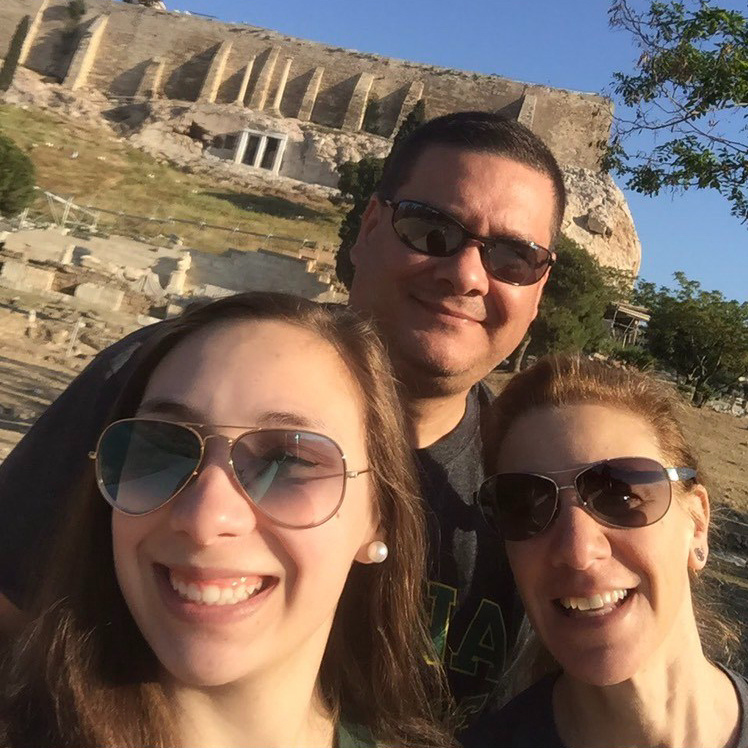
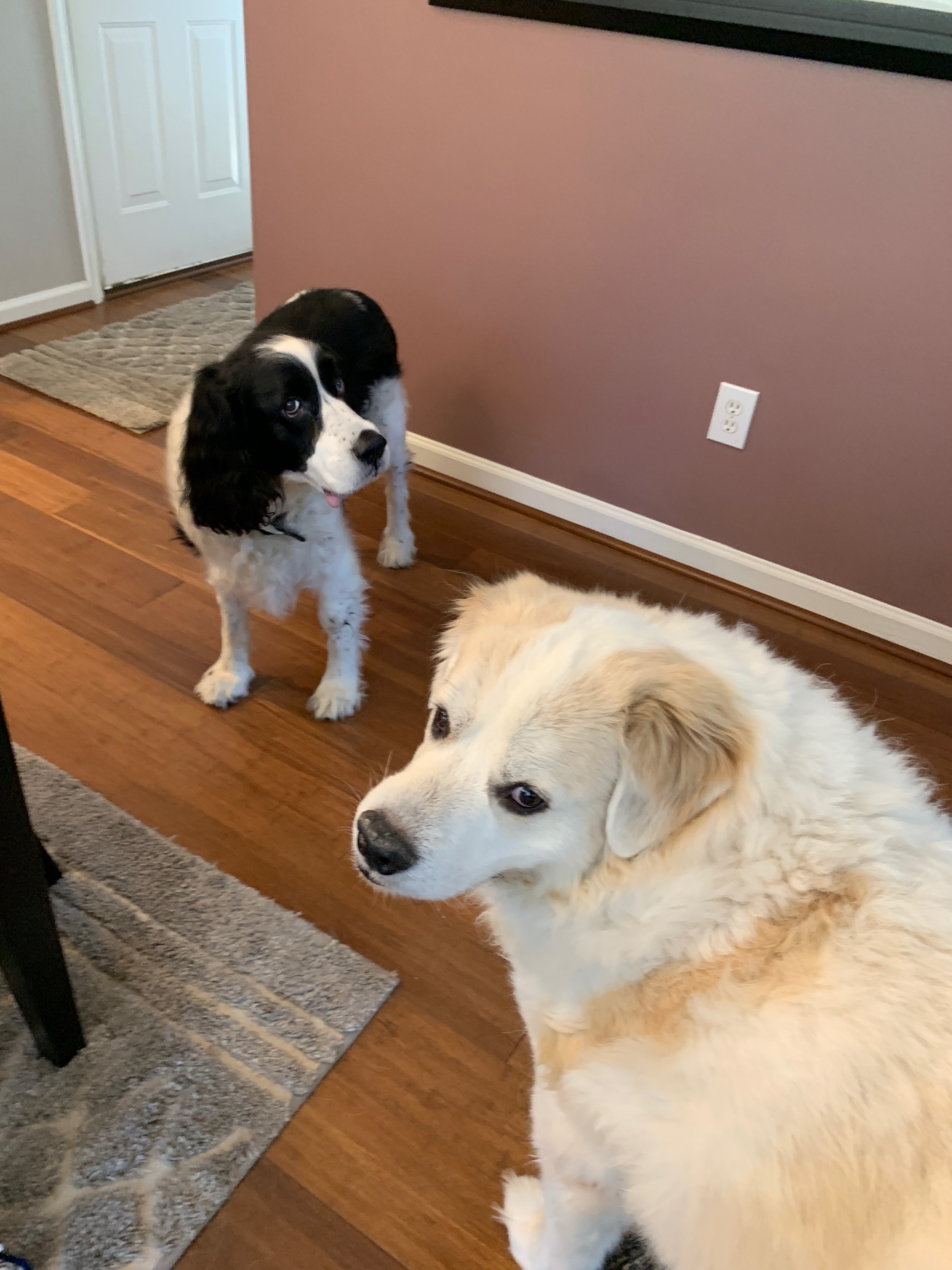
Left: Images of my family and I, Right: Images of my two dogs
I am an only child, which comes with some additional pressure sometimes. The national percentage of households with only one child is 20% (The Seattle Times). My parents are very into genealogy. Genealogy is defined by Cohen as, “the study of ancestry and family history” and often entails looking back through generations for a feeling of connection to a larger family tree (Cohen, 3). My father has taken an Ancestry.com test before, and it confirmed what we already knew, that we have a strong Italian lineage. My family, even though we identify as American, has a very strong Italian heritage and pride even if we do not have the distinct Italian features. As previously stated, my family is very big into genealogy, and this was reaffirmed by my uncle doing a genealogy test. My uncle, mother’s brother, through genealogy was able to learn about for the first time and meet his daughter that was unknown to him until 30 years later. Even though this new found cousin is in my biological family, I wouldn’t consider them to be in my personal family. A personal family is defined as, “the people to whom we feel related and who we expect to define us as members of their family as well (Cohen, 6).
As I was growing up, there was a strong emphasis on education. It is constantly described to me that school is my “job”. I began my educational journey in the Catholic school education system in preschool, which I am still a part of through college. The number of students that are a part of a Catholic elementary or middle school is 1,274,162, and the number of students in secondary schools is 561,214 (NCEA). The Catholic school education system prepared me to be successful academically, but it did not enrich my spirituality because I am not Catholic. The percentage of non-catholics enrolled in Catholic schools is 19% or 349,139 (NCEA). It was not very diverse, it was mainly composed of wealthier white kids, and in turn is not reflective of the society we live in. The percentage of white students in Catholic schools is 72.2% (NCEA). My father had the same Catholic school experience, which is an important thing we have in common. Overall, Catholic education really allowed me to be successful and build a solid foundation.
My family does have a few veterans as well as public servants to which I feel very connected. The most notable being my grandfathers; a naval officer and a fire chief. Although I was not really able to meet either of them because I was still a baby when they passed, I still feel a very strong connection to them. The symbolic interaction theory can be applied to this situation. The symbolic interaction theory focuses on the roles people play in their life and how they interact with other individuals to uphold these various roles (Cohen, 20-21). It can be seen that I play the role of a grandchild by spending lots of time with my living grandmothers. This is upheld by talking about my grandfathers, learning about who they were, and being able to learn from their memories. Their memories live on through stories, honors, and special designations they have both received. My uncle even has a tattoo in memory of my grandfather. Through my family, I have learned that we are in a state of perceptual learning and adaptation into the changing society.
Cohen, Philip N. 2015. The Family: Diversity, Inequality, and Social Change. University of Maryland. First edition.
 Jenna's Blog